.avif)
-
27/8/26 2:49 pm


Under the new rules on damp and mould, it’s vital you have the records to back up your story, otherwise it could come back to bite you.
Tom Entwistle, LandlordZONE
After a blazing hot summer, it’s hard to imagine that in the UK we will be back to those cold, wet and damp autumn and winter evenings. But back we are, and if you manage residential tenancies in England, you have a very important issue to be concerned about. These are the new rules introduced by the Renters’ Rights Act.
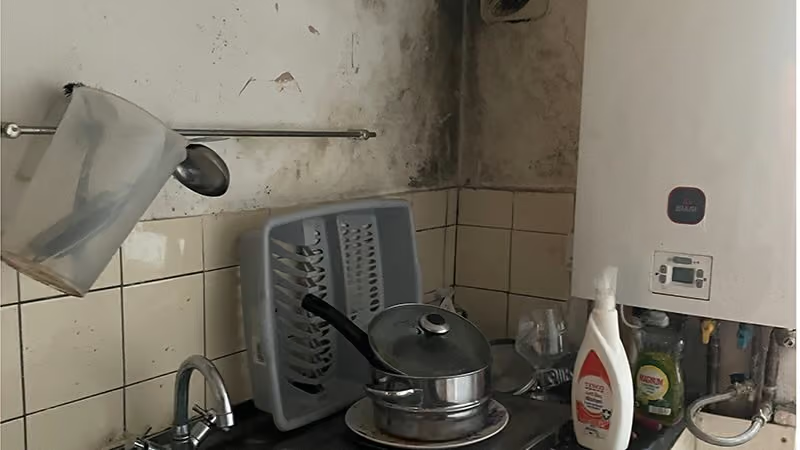
As the nights draw in and the heating goes on, first reports will come in of condensation on windowpanes and black mould on bedroom walls and window reveals. Most will be condensation, but some will not. This winter, though, how a landlord responds – and how well that response is recorded – will matter more than ever.
The mechanics of condensation are familiar enough to most experienced landlords. Warm, moist air produced by cooking, bathing and drying clothes rises and as it does it meets cold surfaces – an external wall, a single-glazed pane, the back of a wardrobe pushed against a gable end wall.
All this steam turns to water. Repeat that process night after night as tenants return to a cold house and mould follows as sure as night follows day. Britain's extortionately expensive energy makes it even worse, as households heat fewer rooms for shorter periods. Cash strapped tenants will invariably skimp on heating and live a very uncomfortable life because of the cold
Well-meant improvements can add to the condensation problem when new windows, draught-proofing or insulation go in without a matching ventilation system. There are two key things that produce a condensation free home: (1) extracting steam at source, no clothes drying on radiators, and providing good general ventilation short of cooling the rooms down, and (2) keeping all rooms to a good and comfortable minimum temperature.
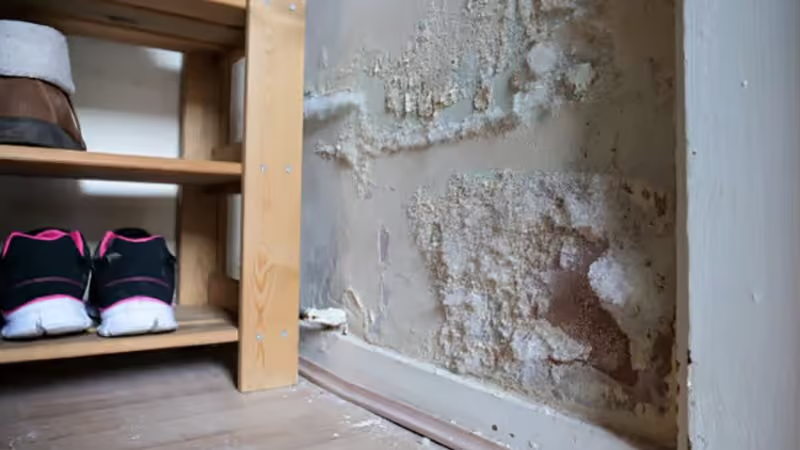
Not every black patch is condensation though. Structural issues such as penetrating damp, rising damp and slow leaks can also cause these problems which look much the same. Getting an accurate diagnosis is the first crucial task.
Be aware that some damp specialists have a vested interest in finding issues and will sometimes recommend expensive solutions that are wide of the mark and don’t work in the end. Try to get an unbiased opinion.
This article relates to the private rented sector in England. Wales applies its own fitness-for-habitation regime under the Renting Homes (Wales) Act 2016, and Scotland has introduced separate Awaab's Law regulations.
It is for general information only and does not constitute legal advice. Landlords should take professional advice on their specific circumstances. The timescales and the commencement date for applying Awaab's Law to private tenancies remain subject to consultation.
Awaab's Law has applied to social landlords since 27 October 2025. This law is named after two-year-old Awaab Ishak, who died in 2020 after prolonged exposure to mould in his family's housing association flat in Rochdale.
The law requires social landlords to investigate and make safe emergency hazards within 24 hours. They must investigate significant damp and mould hazards within 10 working days, give the tenant a written summary within three working days of that, and to begin remedial work within five working days of that.
Private landlords come next. Section 60 of the Renters' Rights Act 2025 already provides for the same framework to cover private tenancies in England, but it has not yet been brought into force.
On 8 October 2026 the Government launched a consultation about how and when to implement the measure, which closes on 18 December 2026. The private-rented-sector timescales and start date on this are therefore not settled, but the intention is clear. The social model is the obvious template and this winter will prove a dress rehearsal for private landlords.
None of this means private landlords currently operate without responsibility for damp and mould. Since 2019, section 9A of the Landlord and Tenant Act 1985 has required rented homes to be fit for human habitation throughout the tenancy, and damp is one of the listed matters.
Under the Housing Health and Safety Rating System (HHSRS), damp and mould growth is evaluated as a Level 1 Hazard, the highest level of risk of respiratory illness and structural harm and severity of impact on vulnerable groups.
Councils assess damp and mould growth as a hazard under HHSRS. Since 22 June 2026 under a new section 6A of the Housing Act 2004, inserted by the Renters' Rights Act, councils have been able to impose a civil penalty of up to £7,000 where a Category 1 hazard has not been removed when it would have been reasonably practicable to do so.
Looking further into the future of private rented housing safety, the Government has confirmed that a reformed Decent Homes Standard, previously applying only to social housing, will apply to private rented homes from sometime in the 2030s.
In 2023 the Government produced guidance on the health risks of damp and mould, written for all rented housing providers, This guide sets the tone of what councils and courts will expect from landlords and agents. Basically it means they must act urgently where health and safety concerns arise and not wait until medical evidence arises.
This is where experience counts. Amritan Walia of Damp & Ventilation says the first report of mould is rarely where things go wrong. It is the second and third. The pattern will be familiar to many landlords and agents: a contractor visits, treats the mould, applies anti-fungal paint and closes down the job. By January it is back with a vengeance, the tenant is frustrated and complains yet again, and the landlord's file contains a contractor’s invoice but little else.
With Section 21 gone for good, those frustrations on both sides no longer end with a tenancy quietly coming to an end. They surface instead in council inspections, in disrepair counterclaims, in tenants defending Section 8 arrears cases, in rent repayment applications and, before long, in complaints to the soon to be enabled, the new private rented sector ombudsman.
We have written before on LandlordZONE many times about the documentary burden the Renters' Rights Act places on landlords. The pressure on courts and tribunals will likely experience and damp will inevitably become a recurring theme. In each of these scenarios, what will be decided is less about what the landlord did than what the landlord can prove what was done.
Awaab's Law does not demand the impossible and recognises that sometimes damp is an intractable problem. In the social sector, section 10A(5) of the 1985 Act gives a defence where the landlord used all reasonable endeavours to comply, and the Government's guidance gives examples such as failed attempts at access or an inability to source contractors or materials.
10A (5) – “In any proceedings for a breach of the covenant that is implied by subsection (2), it is a defence for the lessor to prove that the lessor used all reasonable endeavours to avoid that breach.”
It is, however, equally clear that landlords will need to provide solid documentary evidence as to why a failure was unavoidable. There is no reason to expect that the same approach will not apply to private lettings.
The starting point is a simple time-line. Record when the tenant says they first noticed the problem and, separately, when you or your agent received the report. The two are often different. Keep the original message, text or email if received in preference to your own notes, though contemporaneous notes in a diary can still prove useful in court.
If there are gaps in the early history, be honest and say so, rather than guessing or investing a story which could come back to bite you.
Ask the tenant for their experience. What happened between visits. Did the problem go away after the last lot of work, and when did it return? Has it got worse? Record their account and attribute it to them, even if this account differs from what the contractor saw and reported on one particular day.
All photographs should be dated and labelled with the room, using consistent room names throughout. A close-up shows the detail. A wider shot shows where the issue sits in relation to windows, external walls and furniture. Keep earlier images alongside new ones. Don’t be tempted to hold up work to take pictures. Your record should report the response, not replace it.
Keep survey reports in full, including the limitations and recommendations sections that tend to be skipped. Quotations should be kept separate from invoices and completion records, because a quote shows only what was proposed.
If recommended work was not carried out, make sure you note the reason, the cost, getting access, or wanting a second opinion. Any unexplained gap will be read in the least favourable way.
Log changes to the building too. Replacement windows, loft or wall insulation, a bathroom refit that provided a new extractor, the repair of a leaking gutter. Record the dates and specifications you hold without deciding for yourself which change caused the problem.
For older, solid-walled properties all this is especially important. The 2022 joint position statement from RICS, Historic England and the Property Care Association asks investigators to consider construction and past alterations. Inappropriate modern materials are a common culprit.
Above all, don’t close your record at the invoice date. Government guidance recommends a follow-up visit after remedial work, with further investigation work if damp or mould returns. A note of that follow-up, and the tenant's view of whether the problem has been resolved is often the most valuable piece of evidence in your file.
Where damp recurs and you have exhausted your ideas, a fresh pair of expert eyes is usually warranted. Look for demonstrable experience in diagnosing damp and building pathology rather than relying on professional membership alone. Be cautious of those "free surveys" from firms whose business is selling the treatment they recommend.
Send the surveyor the full timeline of events with all supporting documents before the visit. Indicate clearly which areas remain affected, which earlier conclusions need revisiting, what could not be inspected last time.
Ask what the visit will cover and what form the report will take. Afterwards, add the report and agreed actions to your records, with who is responsible and when progress will be checked.
Give your tenant a short written summary of findings and the next steps to be taken, effectively mirroring the social-sector requirement. It is good practice to keep the tenant fully informed and will allay their concerns - it is very likely to be a legal obligation later.
Many delays in tenanted properties come down to access. Give at least 24 hours' written notice, offer a range of appointment times, use more than one method of contact and keep a log of every attempt. The social-sector guidance says it expects tenants to engage, but it also expects the landlord to have made genuine efforts to communicate – and to be able to prove it.
Educational advice for your tenants on heating and ventilation still has its place, provided it is given sympathetically and constructively and is recorded. A tenant who is unaware of how to avoid condensation and mould, how the extractor fan and trickle vents work, or the dangers of drying on radiator, will benefit greatly from a careful explanation.
Offering to provide a hygrometer to monitor the water content of the air and handing a leaflet of how to manage it could resolve the issue permanently. Blaming them outright for their lifestyle, washing, drying, heating, is likely setting you up for a dispute.
When Awaab's Law reaches the private sector, if not before, any likely disputes over damp and mould will be decided by your records. What was reported to you, when, what was done about it and whether it worked.
Landlords and agents who build the recording habit into their routine this winter will find the new regime far less daunting in the future. If you have views on how all this should work for small landlords, you have until 18 December to respond to the consultation.
This article is based on some information supplied by Amritan Walia of Damp & Ventilation
See also:
RICS advises checking a surveyor's relevant damp and building-pathology experience; membership alone does not establish that specialism.
LandlordZONE - Damp and mould pose biggest challenge under Awaab's Law
Consultation - Extending Awaab's Law to private rented tenancies and to licences
[Main image credit: Valentin Ivantsov]
Tags:












%20(800%20x%20450%20px).avif)
.avif)





Comments