.avif)
-
27/8/26 2:49 pm


By Tom Entwistle, LandlordZONE
A young professional just starting out in London on an entry-level salary can expect to hand over an estimated two-thirds of their gross pay to their landlord. In Doncaster that figure is closer to one-fifth – 20 per cent.
Those are the headline figures from new research by trading and investing platform XTB, which compared salaries, rents and everyday living costs across 30 of the UK’s most populated cities.
The study was carried out with tenants in mind, but these findings hold just as many lessons for the landlords and agents as they do for young professionals. In fact, it is estimated that around 60 per cent of UK renters aged 25 to 44 had expected to own their home by now, but this study shows just how far housing costs have pushed back these young people’s plans.
Young professionals are a core market for many small-scale landlords. All the available evidence shows they are renting for longer. The English Housing Survey puts the private rented sector at 4.7 million households in England, 19 per cent of the total, with 69 per cent of households headed by someone aged 16 to 24 renting privately. The question as to whether those tenants can afford the rent, and keep affording it, matters to anyone letting to them.
On rent alone, according to XTB’s research, Doncaster comes out as the cheapest place to live at an average rent of £508 a month. That’s roughly one -quarter of London’s average of £2,207. Sunderland comes in at around £590, with Bradford at around £643 to follow, and Leicester and Wakefield all competing for the top five slots.
XTB’s overall affordability ranking, which it claims also weighs entry-level salaries, transport costs and disposable income, tells a slightly different story.
Here, Coventry takes first place with an average entry-level salary of £31,000, rent of £1,026 and a £60 monthly transport pass which leaves an average of £914 a month in disposable income. That’s more than double London’s £381. Wakefield with rents around £750, disposable income is £878 and Sunderland, rent at £590, gives a disposable income of £857, taking second and third places.
Across all the cities studied by XTB, rent takes an average of 40 per cent of a young professional’s gross monthly salary. In London that rises to 66 per cent, Bristol to 55 per cent and in Edinburgh to 50 per cent. In Doncaster on the other hand, it falls to 22 per cent, the cheapest in the UK.
Perhaps the most telling comparison, says XTB, is between the eight cities that share the same £30,000 average entry-level salary. The disposable incomes range from £918 a month in Chester to £581 in Manchester, that’s a gap of £337 a month, or about £4,000 a year, when the pay is the same.
Kathleen Brooks, Research Director at XTB, has summed to up by saying:
“It’s the amount left over, not the salary itself, that determines how much room a young professional has to save or invest.”
XTB is, of course, in the business of encouraging people to save and invest. The framing of their study reflects that. But that is no reason to dismiss their figures, it is simply a reason to read them as a snapshot rather than official statistics.
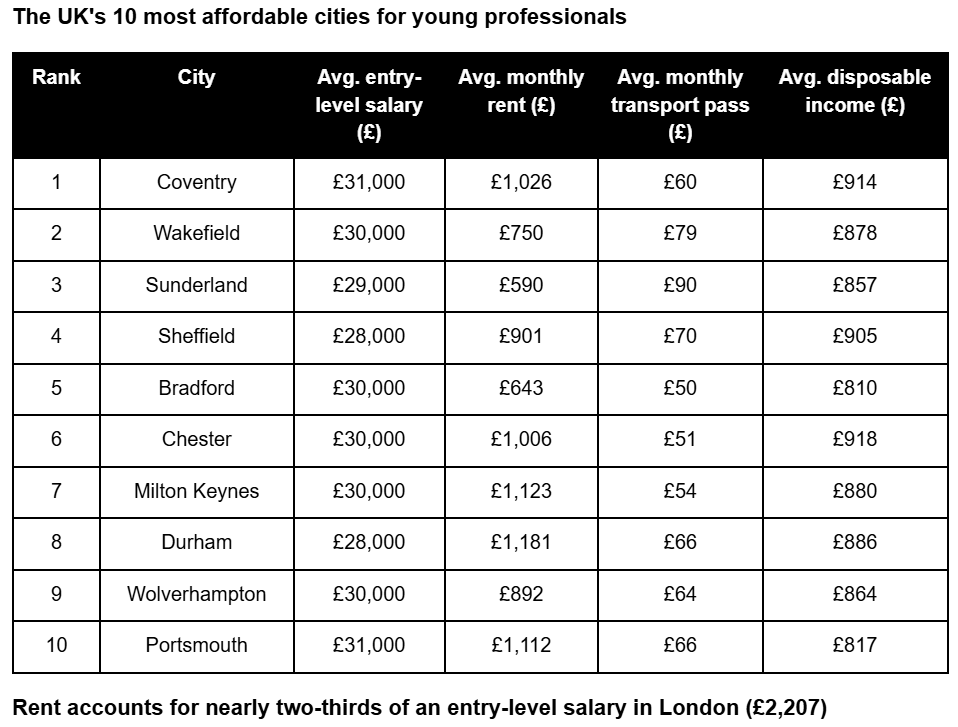
XTB has not published its full methodology, and the rent figures appear to be city-centre asking rents for a one-bedroom flat rather than the average achived rents which to be fair would be very difficult to source.
That does matter, because different studies produce very different numbers for the same place. Two other studies published this year put the average rent in Doncaster at about £684 a month, a third higher than XTB’s £508.
At the other end of the scale, the Office for National Statistics put the average London rent at £2,332 in August 2026, across all property sizes. So, consistency is difficult to achieve, but nevertheless the overall message is clear.
The official benchmark is the ONS private rental affordability measure, which treats rent of 30 per cent or less of gross income as affordable. On the ONS latest figures, for the year to March 2024, a private renter on median income in England would spend 36.3 per cent of it on an average rent.
ONS shows London as the least affordable region at 41.6 per cent and the North East the most affordable at 19.8 per cent. The ONS measures use household income, which often includes more than one earner, so it is no surprise that XTB’s single-salary figures look starker in comparison.
None of this invalidates the research. The direction of travel is clear and consistent across every source. But landlords setting rents or judging demand should rely on the rents achieved locally, not national league tables. That’s a point I made in my earlier article on achieved-rent evidence before the First-tier Tribunal.
The more practical question for landlords is what these figures mean when a tenant applies. Most referencing still applies a rule of thumb that annual income should be at least 30 times the monthly rent. Applied to XTB’s own figures, the results are revealing:
• London: rent of £2,207 requires an income of £66,210, against an entry-level salary of £40,000.
• Bristol: £44,160 required, against £32,000.
• Manchester: £40,650 required, against £30,000.
• Edinburgh: £36,150 required, against £29,000.
• Coventry: £30,780 required, against £31,000, a narrow pass.
• Doncaster: £15,240 required, against £28,000, with ample headroom.
In other words, a single young professional on a typical starting salary would fail standard referencing for a one-bedroom city-centre flat in most of the UK’s larger cities.
In practice, such applicants tend to share, rely on a guarantor or look elsewhere. It helps explain the continuing demand for well-run shared (multi-occupied) housing in the major cities, along with the landlord’s licensing obligations that go with this type of housing.
Landlords based in England should remember that the Renters’ Rights Act has removed one traditional workaround. Since 1 May this year, a landlord or agent can request more than one month’s rent in advance. and this only after the tenancy agreement has been signed and before the tenancy actually begins.
Councils can impose penalties for breaches of this ruling. Rental bidding is also banned, so landlords must publish an asking rent and cannot ask for, encourage or accept any offers above that and with penalties of up to £7,000. Guarantors and rent guarantee insurance remain legitimate protections, but a large upfront (rent in advance) payment can no longer be used as an offset for a weak affordability check.
With possession now available only through Section 8 grounds, a tenancy that starts off under financial strain is a much greater risk than it was when Section 21 was available. So, getting affordability right at the outset is the best protection for both parties.
The latest ONS figures suggest affordability is already constraining rental growth. In the year to August 2026, average UK rents rose by 3.8 per cent to £1,400 per month and rents in England rose 4.0 per cent. London, which is the most expensive region at £2,332, saw growth of just 3.5 per cent, a figure that’s below the English average. In the North East, the cheapest region at £788, recorded a 5.8 per cent increase, making it joint highest with the North West.
Some of this movement is catch-up in areas where rents had started from a low base. But it also reflects a simple reality, where rent already absorbs half or more of a tenant’s income, there is little room for further increases.
That fact has a bearing on rent reviews under the new Renters’ rights regime. A tribunal considering a Section 13 increase looks at the open market rent, but this market rent is itself limited by what tenants in that area can afford to pay. Any increase beyond a tenant’s ability pay is likely to end in a tribunal challenge, rent arrears or a vacant property.
For investors, the cheaper cities have obvious attractions. Tenants can afford the rent comfortably, property purchase prices are lower, and gross yields are usually higher. But there are some trade-offs in these locations. Capital growth is generally weaker, graduate job markets are smaller and therefore demand from young professionals is lower than in the major cities.
There is an important further point here that’s easily overlooked. Many of the costs of letting a property are much the same whatever the location and rent. The safety certificates, energy efficiency improvements, licensing, insurance and, before long, registration on the new landlord database are all similar. Given a £500 monthly rent, those fixed costs take a far larger share of income than when they rent it £1,500 rent.
Coventry’s top ranking is perhaps the most useful lesson for landlords. It is neither the cheapest nor the most expensive city, but it combines reasonable wages with moderate rents and low transport costs.
For landlords, the most dependable lettings are often found in that middle ground. This is where tenants earn enough to pay the rent without too much strain, and demand is strong enough to keep your voids short.
Kathleen Brooks is right that what is left over matters more than the headline salary. The same is true for landlords. A rent that leaves a tenant with little to spare may look good on paper, but a rent the tenant can keep paying is worth more over the life of a tenancy.
XTB’s research covers cities across the UK, including Belfast, Cardiff and Edinburgh. The legal points in this article, including the Renters’ Rights Act provisions on rent in advance and rental bidding, apply to the private rented sector in England only. The ONS affordability figures quoted are for England.
This article is for general information only and does not constitute legal, tax or financial advice. Landlords should take independent professional advice given their own circumstances before making decisions.
Tags:












%20(800%20x%20450%20px).avif)
.avif)









Comments