.avif)
-
27/8/26 2:49 pm


Landlords in Portsmouth have seen a noticeable shift in the kinds of enquiries from prospective tenants in recent months: people with very limited budgets, often with previous tenancy challenges, looking for rooms or small flats that simply don’t exist at the price they can afford.
A typical room in a shared house in Portsmouth now starts at about £500 a month while a one‑bed flat is rarely below £900. Local Housing Allowance, meanwhile, sits at roughly £422 and £650 respectively. The gap is no longer a matter of a few pounds that can be bridged with careful budgeting or a sympathetic landlord.
Many of the people approaching us are not irresponsible or unrealistic; they are simply priced out. And while it’s tempting to imagine that the answer lies in higher benefits or cheaper (lower‑standard) housing, neither of those options is politically or socially acceptable.
If we are honest, the maths at the bottom end of the market no longer works. The PRS is being asked to house people whose incomes are too low, whose support needs are too high, and whose risks are too great for a system built around private investment and commercial tenancies.
The PRS was never designed to be the primary safety net for the most vulnerable, yet that’s increasingly what it has become as fewer council houses are built and the existing ones are occupied by tenants who are not going to move out and pay market rates when the alternative is to sit tight and enjoy a heavily subsidised rent.
The only politically viable path is to reduce the risk, not the rent. We are beginning to see models that work, such as council‑backed guaranteed rent schemes, and ‘PRS‑plus’ where the landlord retains a normal private tenancy, but the council or a partner organisation provides support to make a higher‑risk tenant viable.
None of this removes the need for more housing, but the most effective supply‑side intervention is not vast new social housing estates, it is increasing the stock of mid‑market homes. When more of these homes – typically £250k–£450k in much of Portsmouth - are built or refurbished, people move up, freeing older and cheaper properties. While for those with the most complex needs, supported housing must expand.
Taken together, these approaches form a coherent ecosystem: the PRS for working households; PRS‑plus for low‑income households; supported housing for vulnerable households; social housing for long‑term stability; and mid‑market development to keep the whole system flowing.
The PRS can’t be expected to house everyone. But with the right risk‑reduction tools, it can house far more people than it currently can - and at far lower cost to the public purse than the alternatives.
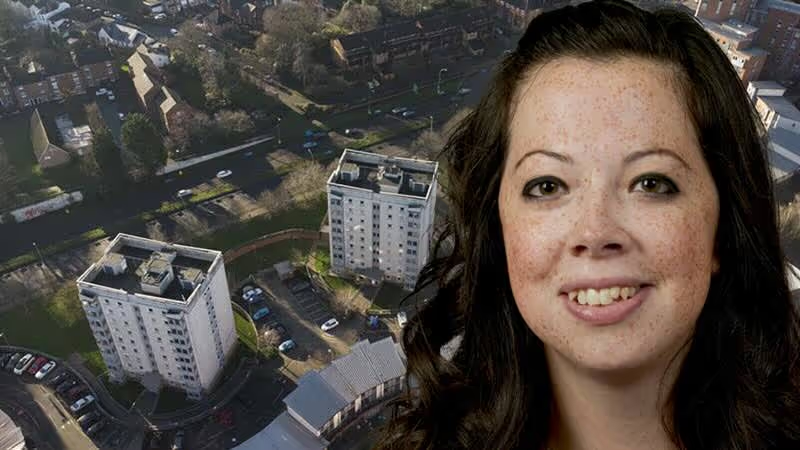
Martin Silman is vice chairman of the Portsmouth & District Private Landlords Association
Tags:









%20(800%20x%20450%20px).avif)
.avif)






Comments