.avif)
-
27/8/26 2:49 pm


Article 4 directions are a very blunt instrument. They allow councils to restrict the creation of new HMOs, but don't necessarily address the local impact of poorly managed properties.
If the government wants to improve standards in shared housing, I would rather see councils given sharper tools to tackle bad operators than broader powers to restrict supply. I’m not really advocating for additional licensing schemes. I think a lot of landlords see this as effectively another fee for the operators who are already trying to do things properly, while the worst operators are often the ones least likely to engage with the system in the first place.
I’d rather see HMO licensing place much greater emphasis on the actual management of the property. Is it well managed? Is waste managed properly? Is anti-social behaviour tackled? If not, councils should have meaningful powers to intervene, including enforceable management requirements covering issues such as waste, parking and antisocial behaviour. Where an operator repeatedly fails to meet those standards, councils should have meaningful sanctions, ultimately including the ability to prevent a property operating as an HMO.
But that has to work both ways. If landlords and managers are expected to take responsibility for behaviour within their properties, they must also be given effective tools to police it themselves. The Renters’ Rights Act has removed Section 21, meaning we need strong, workable grounds to deal with anti-social behaviour, rather than leaving responsible managers accountable for problems they have limited power to resolve.
You can't simultaneously give managers more responsibility and less ability to manage. There’s a role for greater local control because pressures aren't identical everywhere. Parking might be the biggest issue in one area and waste or anti-social behaviour in another, but devolution shouldn't mean dozens of completely different regulatory systems.
I'd favour a clear national framework for shared housing, with councils given defined additional powers that they can apply locally. For somebody with one or two HMOs, that shouldn't mean more bureaucracy. We should make life simpler for responsible landlords: meet clear standards, manage your properties well and comply with reasonable local conditions, and you should be able to operate.
We also need to recognise how the shared housing market has changed. COHO's State of Shared Living research found that 94% of sharers are either working or studying, with 64% in full-time employment - just 3% are unemployed.
The objective of HMO policy shouldn't simply be fewer HMOs. It should be fewer bad HMOs - and many more good ones.
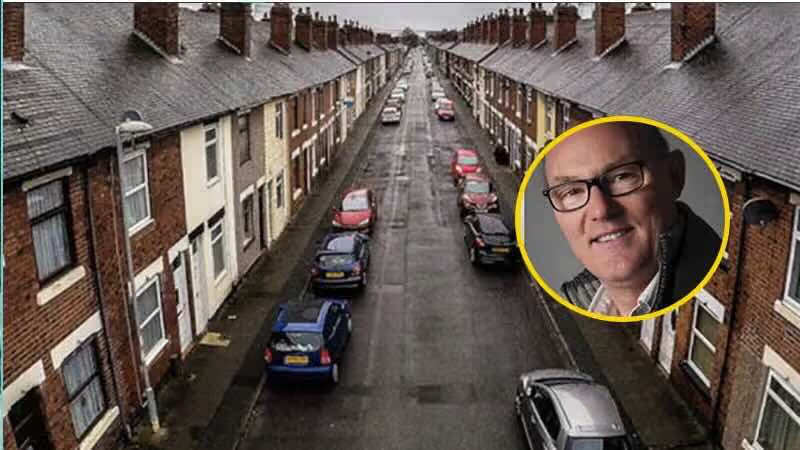
Vann Vogstad is CEO of HMO management software business COHO
Tags:










%20(800%20x%20450%20px).avif)
.avif)







Comments