.avif)
-
27/8/26 2:49 pm


As the government presses ahead with plans to ban new leasehold flats through the introduction of commonhold, many in the property industry are sounding the alarm.
If leasehold tenure is banned for new flats, the only, current, viable alternative will be commonhold – a model that, despite being introduced in 2002, has failed to gain meaningful traction. Developers, lenders, and managing agents remain wary of commonhold’s limitations: its lack of flexibility, the absence of a single controlling entity and the potential for disputes to escalate quickly in the absence of a freeholder with legal authority.
The danger is that we could end up with a two-tier market: older flats held on tried-and-tested leasehold structures, and new flats sold as commonhold under untested, inconsistent and lender-cautious frameworks. Purchasers, mortgage providers, and even conveyancers may view commonhold units as riskier or less saleable, pushing prices down relative to traditional leasehold flats.
Professional freeholders, whether individuals, housing associations, or specialist asset managers, play a vital role in safeguarding long-term building standards. Removing them from the equation entirely leaves governance in the hands of residents, who may lack the expertise, time, or willingness to act collectively.
A more balanced reform would be to retain leasehold for flats but under stricter regulation; transparent service charges, caps on ground rents, and easier rights for leaseholders to take over management or extend leases.
Leasehold, properly regulated, remains an efficient and proven structure for complex residential buildings. Banning it entirely could do far more harm than good – creating uncertainty, stifling development, and ultimately dividing the flat market into two unequal halves.
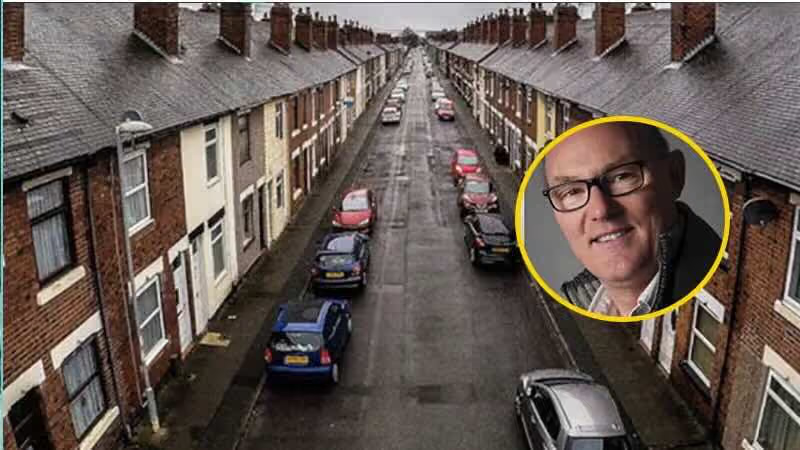
Clive Scrivener is a partner at chartered surveyor Scrivener Tibbatts and a member of ALEP (Association of Leasehold Enfranchisement Practitioners).
Tags:











%20(800%20x%20450%20px).avif)
.avif)



%20(1).avif)


Comments