.jpg)
-
22/10/26 11:05 am


EPC “C” by 2030 – how do you plan to meet this high standard?
The government has confirmed that an EPC “C” is the minimum standard for all private rented properties by 1 October 2030.
For some, achieving the standard will be relatively easy, but for those landlords with older properties it could be much more of a challenge.
You must act methodically; start planning now by doing the basics, auditing your properties, keeping proper records, and making use of any available financial support. If you do this, you will be well placed to comply without a last-minute panic.
We are now in a new rental property era in England, with the passing of the Renters’ Rights Act and the other UK nations, Scotland, Wales and Northern Ireland, have all gone down a similar path.
For several years, landlords faced a confusing message on energy efficiency targets. New proposals and deadlines came and went, government support and cost caps had shifted, and the new regulatory framework was far from settled.
All these uncertainties encouraged landlords to just wait and see. But now it seems that's all over – we know where we stand.
This article applies primarily to England & Wales and is not a full interpretation of the law. Always seek professional advice before making or not making decisions. Use this guide as the starting point for your research, not an endpoint.
This January 2026, the government published its Warm Homes Plan. It confirmed that all privately rented properties in England and Wales must achieve a minimum Energy Performance Certificate (EPC) rating of grade “C” by 1 October 2030.
This same deadline applies to all tenancies. There’s no requirement for new tenancies to comply earlier – the earlier proposed 2028 interim deadline for new tenancies has been removed.
Non-compliance will carry severe financial consequences with fines of up to £30,000 per property; that’s a significant increase from the previous £5,000 maximum.
The current cost-based EPC rating system (EER) is being replaced by a dual-metric system where (1) a Fabric Performance Metric measures insulation and heat retention and (2) a Heating / Smart Metric gives a choice between installing a low-carbon heating system (e.g., a heat pump) or a smart readiness system (e.g., solar panels).
If you have an EPC of rating C or better on your property under the current system before October 2029, it will remain compliant for 10 years, even if it runs to after 2030. If you can improve your properties to a C rating before 2029, you gain the advantage of these "grandfather" rights under the old, less strict assessment regime.
The scale of the task facing the private rented sector as a whole with its preponderance of older rental properties is considerable. Around 52 per cent of private rented sector properties in England and Wales are currently rated well below Band C. It means the majority of landlords will have a big improvement job ahead of them.
The question now is not if you must act, but how you do it quickly and intelligently.
Landlords with older properties – particularly Victorian terraces with single solid brick outside walls, or rural buildings, again with solid walls and non-standard construction – are presented with a real challenge.
This article sets out how to approach the task systematically.
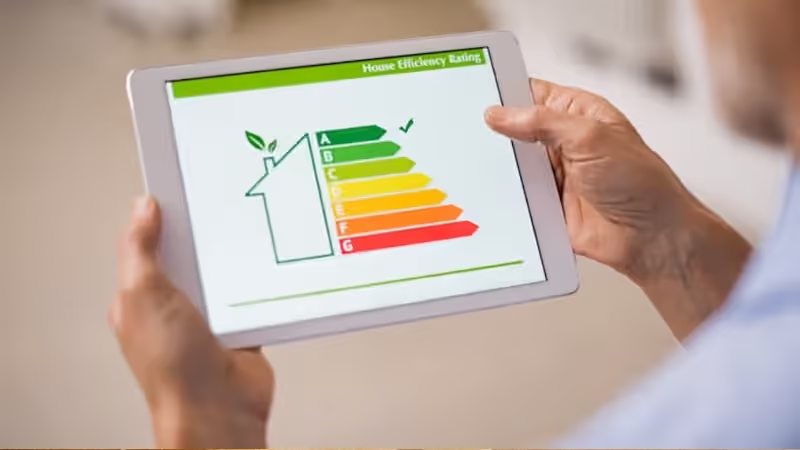
An Energy Performance Certificate rates a property on a scale from A (most efficient) to G (least efficient). It’s based on an assessment of the building’s construction, insulation, heating system, hot water provision, and lighting. It calculates an estimate of typical running costs and carbon impact, and once produced, it’s valid for ten years.
Historically, the methodology — known as the Reduced Data Standard Assessment Procedure, or RdSAP — relied mainly on default assumptions when direct evidence was unavailable.
An updated version, the RdSAP 10, was introduced in June 2025 and was a significant change. It currently operates on a set hierarchy, prioritising documented evidence over mere assumptions. If, for example, a heating upgrade or insulation installation cannot be evidenced with an invoice, guarantee, or building regulations certificate, the assessor may rate the system at a lower efficiency than it actually achieves.
As with many of the requirements within the Renters’ Rights Act, it’s clear that an emphasis on documentary evidence is the order of the day – past improvements that were never properly documented may not count towards your EPC rating.
Landlords and agents will do well in future to make gathering documentation a standard part of the letting process. For self-managing landlords the starting point is to have a file for each property containing all relevant paperwork: Capital expenditure, installation invoices, FENSA or CERTASS certificates for windows, Gas Safe records, building regulations completion notices, and any guarantee or warranty documentation for insulation work.
This regulatory timetable matters, because there is a definite advantage to acting before October 2029. Here are some key dates:
The new “Home Energy Model” is expected to be more demanding than the current system. It will have greater emphasis on fabric performance (the building’s structure), smart readiness, and low-carbon heating.
If you can achieve an EPC C under the current methodology before October 2029, you will “lock in” your compliance for up to ten years, thereby avoiding the stricter HEM system.
The cost cap is now set at £10,000 per property. This is the maximum a landlord can be required to spend on energy efficiency improvements before qualifying for a cost cap exemption. This allows the property to continue being let. For properties valued below £100,000, the cap is calculated as 10 per cent of the property’s value instead.
The cap includes the cost of obtaining an EPC and specialist advice, which is a useful provision. Landlords who commission a proper assessment and take professional advice before making improvements can count those costs toward the limit. The government is yet to confirm whether or not the cost of planning permission or listed building consent will also count.
Any qualifying expenditure made since 1 October 2025 already counts toward the cap. Landlords who have fitted loft insulation, upgraded a boiler, or installed cavity wall insulation in the past few months should keep all invoices, as that spending will count towards the limit.
Several grant schemes are available that can also reduce the net cost of compliance significantly. The Warm Homes Local Grant is designed to support private landlords with tenants on low incomes in properties rated D to G. The Energy Company Obligation (ECO4) and the Great British Insulation Scheme offer further funding options.
Any grant funding received counts toward the cost cap. This means it reduces the amount a landlord must spend from their own resources before qualifying for an exemption.
'Fabric First' is the most important principle to understand. It means addressing the building structure, the walls, roof, floors, windows, and doors. You tackle these before spending money on mechanical or renewable items. A well-insulated, draught-proofed home retains more heat, which means any heating system, even if it’s an older one, operates more efficiently and runs less often.
These fabric measures also tend to give greatest improvements relative to their cost.
Loft insulation (none to 270mm) can improve an EPC score by 10 to 15 points. It’s perhaps the most cost-effective measure you can make, and it’s relatively straightforward to install, even as a DIY job.
Cavity wall insulation, where the property construction allows it. This typically costs between £350 and £500 and can add 5 to 10 points to a rating. It is not suitable for all property types, and any cavity must be in a suitable condition.
Draught-proofing by blocking unnecessary gaps around windows, doors, letterboxes, loft hatches, and pipework is a low-cost intervention giving a meaningful impact on comfort and energy use. It is again a possible DIY job.
Hot water cylinder insulation by fitting an insulation jacket to an uninsulated cylinder is inexpensive, easy to install by anyone and can add 1.5 to 2 points to an EPC score.
LED lighting, replacing incandescent or halogen light fittings with LED equivalents uses up to 90 per cent less energy and adds 1 to 2 points to an EPC rating. This is one of the cheapest and easily installed improvements available.
Suspended timber floor insulation is underestimated as an energy loss improvement. Older properties often allow cold air to enter through gaps in suspended floors, particularly where there is an open flue that creates a draw effect. Properly installed floor insulation can make a big difference to the heat retention and warmth of the floors.
Solid-walled properties present a greater and more expensive challenge. Where cavity insulation is not an option, internal or external wall insulation may be necessary. Either one is more expensive than a cavity fill and especially external, requiring specialist installers. The cost cap becomes most relevant here for older and heritage properties.
An open fireplace or gas fire is an EPC rating destroyer, reducing the EPC score by as much as 10 points. They create a continuous air draw effect so warmed air disappears up the flue. It takes more warm air from the rest of the property and in turn pulls cold air in from outside. This happens even when the fire is not in use.
The options include removing the appliance and capping the chimney, fitting a register plate to seal the opening, or replacing an open fire with a glass-fronted enclosed stove or fire, which eliminates the draw effect.
Once the fabric of a property and these other measures have been tackled, some landlords will find that further improvement is needed to reach Band C. The next stage involves greater investment and more disruption, but these changes will deliver significant EPC gains.
A modern A-rated condensing boiler operates at 90 per cent or higher efficiency and will improve an EPC score considerably. This change will work best with thermostatic radiator valves, programmer controls, and room thermostats.
If a property still has single-glazed windows, upgrading to double or even triple glazing is well worthwhile and will improve both the EPC score and comfort for tenants.
The new Home Energy Model is understood to place greater emphasis on low-carbon heating and “smart readiness”. This means that many properties may require a heat pump or solar photovoltaic panels to achieve the equivalent of a C rating under the new framework. The final metrics have yet to be confirmed.
Air source heat pumps work best in very well-insulated properties, and the installation cost is substantial. The Boiler Upgrade Scheme provides grant support. A solar system improves an EPC score and generates income as well via the Smart Export Guarantee scheme.
These measures require careful financial modelling of payback periods before committing to them and some will require planning permission, particularly in conservation areas or for listed buildings.
The rules described in this article apply to England and Wales. Scotland operates a separate EPC register and has its own proposals for minimum energy standards in the private rented sector.
Here is a practical checklist to reach compliance:
Tenants are facing high cost-of-living pressures and are increasingly attentive to energy running costs and properties with higher EPC ratings. Properties reaching EPC C may attract greater demand, shorter void periods, and some justification for higher rents in the long run.
The cost of compliance, spread sensibly over several years, and combined with some DIY work, is likely to be more manageable.
Take advantage of any void periods to get as much of this work done as possible while avoiding disruptions to tenants.
If you approach the 2030 deadline methodically from 2026 onwards, you will be in a considerably stronger position than those who wait for more clarity. The generally accepted best advice is to get on with it now.
Tags:












.avif)
%20(800%20x%20450%20px).avif)







Comments