.avif)
-
27/8/26 2:49 pm


For years, buy-to-let has dominated the small-scale private investor landscape. Shops and offices have also featured heavily in smaller landlords’ portfolios.
But both these sectors have witnessed the ground shifting as tax changes, regulatory pressures, rising borrowing costs and in the case of commercial, structural changes in the marketplace, have reduced returns and increased risk.
At the same time, another sector has been quietly outperforming with good tenant demand and solid returns.
While residential and high street landlords have been wrestling with the changes - tax increases, legislative reforms, and dwindling demand for shops and offices - light industrial and warehouse units have been benefiting from stronger and persistent demand from the real economy and the shift to online retail.
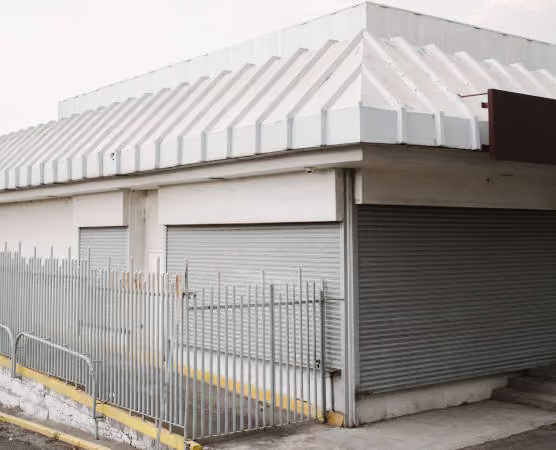
Light industrial typically refers to small to medium size units for workshops, retail park and warehouse use. Often below 5,000 square feet, this mix of storage, trade counters, workshops and increasingly last-mile logistics offer opportunities for enterprising small-scale landlords.
These are not glamorous investments. They are functional buildings usually sited on secondary industrial estates, but they serve the vital small businesses economy. They serve businesses and working tenants who require accessibility, flexibility and affordability.
Small and medium-sized enterprises (SMEs) are the true backbone of the UK economy. Their space requirements are in demand, and the growth of e-commerce, trades-based businesses and hybrid work have increased the need for flexible, local space.
Take-up of this light industrial space has remained strong throughout Covid, and in more recent years, consistently exceeding that of other sectors. At the same time, new business formation continues to grow despite the UK’s flatlining economy.
Every new and expanding enterprise, from a plumbing or electrical firm, or an online retailer, to a specialist manufacturer, needs well located, not necessarily pristine, space at an affordable price.
The UK has been steadily losing industrial space for many years. Residential development, planning constraints and land value pressures have all contributed to a shrinking stock of small, affordable units.
What remains is often outdated or poorly configured for potential uses and the result is an opportunity for the smaller investor to purchase units at affordable prices. There are too few units in many locations, providing a healthy environment for renting out units.
It generally means rents steadily rising, low vacancy rates and strong tenant retention. In other words, in the right location it’s a landlords’ market.
Commercial units in general offer a higher rental yield, 8 per cent is common and up to 20 per cent given advantageous circumstances. Full repairing and insuring (FRI) leases, common in the commercial world for light industrial, offer a clean income profile.
These commercial leases lock tenants in for longer, often three to ten years, and contractual rent reviews can be built in. With FRI, structured leases with full repairing and insuring responsibilities for the building’s maintenance are shifted onto the tenant. This gives a clear dependable return to the landlord.
There are no deposit caps, no deposit placement schemes, no licensing schemes and no consumer rights to worry about. Relations between commercial landlords and tenants are mainly contractual in nature, so lease clause terminology is key and is vital.
Commercial leases are governed by the Landlord and Tenant Act 1954 (Part 2) which means tenants have security of tenure when the initial term ends – in other words the statutory rules only kick-in at that point, meaning tenants are entitled to renew the lease on similar terms to the original.
There is another option. Landlords and tenants agree at the outset to opt out of the statutory rules which means the lease term is the lease term, the tenant does not have a right to renew.
These are by no means risk free investments. Commercial tenants do default on a regular basis. If a landlord takes on a new business tenant, the risk is magnified as new businesses often fail within the first three to five years.
But the big difference between commercial and residential is that defaulting tenants can be removed relatively quickly. With good demand, units can find a new tenant quickly. Not always the case, commercial property can often take much longer to let than a residential property.
Potential investors should bear one thing in mind: an empty unit above a certain size attracts business rates, and insurance cost on a vacant unit is higher than when occupied, sometimes double the cost.
Risk is relative. If a landlord owns a single unit, then a defaulting tenant loses 100 per cent of the landlord’s income, whereas a landlord owning a small retail park with 10 such units, one defaulting tenant losses a faction of the overall revenue – it’s unlikely that more than one or two out of 10 tenants will default at the same time.
The aim for landlords, therefore, should be to grow the business into owning more than one unit. The ideal would be to own the entirety of a small trading estate.
Unlike prime logistics - those larger portal frame warehouses that dominated trading estates, owned by institutions - smaller light industrial property is still within the scope of the small-scale investor. These units trade in smaller lot sizes in the private investor market, which often means buying at auction.
Auction rooms continue to offer units on secondary estates, vacant units with asset management potential and tenanted multi-let blocks of units with reversionary upside. Pricing inefficiencies are common in these situations because the smaller lots fall below institutional interest.
Most professional or institutional investors are not interested in these smaller units, which may be of secondary value to them in less desirable locations. This creates opportunities for those who are willing to navigate a different strategy, including buying tired vacant units in need of refurbishment.
Refurbishing tired units to modern standards takes additional resources, especially given that some will require upgrading to meet EPC standards, so financial planning is everything.
Due diligence is vital when purchasing property at auction. Commercial units on trading estates, or elsewhere for that matter, can be encumbered by lots of legal constraints, title issues, rights of way and access constraints. Tenanted units required comprehensive checks to determine tenant covenant strength.
The speed of auction transactions rewards the well prepared and punishes those who fail to do their homework. Auction purchases are swift and sure but all funds must be in place as there is a limited period before payment in full is demanded.
One clear signal of the health and momentum of this sector comes from lenders willing to offer mortgages.
One such is Paragon Bank, a mortgage provider long established in the buy-to-let market. It has recently launched a development finance product specifically targeting light industrial investment schemes.
Paragon Development Finance has just launched a new light industrial funding product. It is aimed at experienced developers delivering units of 5,000 sq. ft or less. The facility offers funding of up to £10 million over terms of up to 24 months and is designed to support SME developers responding to rising demand for modern, flexible industrial space across the UK.
Demand for small industrial units remains high according to the lender. Occupational demand reached 37.4 million sq. ft in 2025, the highest level since 2022 and 12 per cent above the pre‑pandemic five‑year average, says Paragon. Occupier appetite is particularly high among SMEs, trades firms, e‑commerce retailers and hybrid companies seeking functional, flexible and well‑located space.
ONS data further supports this ongoing demand story for the light industrial sector. Quarterly business demography figures released in January show business creation activity picked up at the end of 2025, with over 71,000 new businesses launched between October and December - a 10 per cent increase year‑on‑year.
This rise in active enterprises suggests improving conditions for SMEs and reaffirms the need for accessible, adaptable industrial space as more businesses start up and scale.
Neal Moy, Managing Director of Development Finance at Paragon Bank, says:
“Our new Light Industrial product reinforces our commitment to supporting ambitious SME developers and responding to structural shifts reshaping the UK’s industrial landscape.
“Across the country, there is an undersupply for small, flexible and well‑located industrial units, with SMEs increasingly looking to grow, improve their logistics capability or bring production closer to home. By providing specialist finance of up to £10 million over 24 months, we are enabling developers to deliver the high‑quality units that modern businesses need to operate, grow and scale.”
He adds: “This new product builds on a series of strategic moves we’ve made in the last year, including a growing footprint in later living, care, PBSA and Build to Rent segments, as well as raising our loan limit from £35 million to £60 million. Light Industrial finance is the next step in ensuring our developer partners have the support, clarity and long‑term relationship focus they expect from Paragon.”
paragonbank.co.uk/development-finance/light-industrial-funding
Working patterns evolve. Larger corporations are rationalising office footprints; economic activity is becoming more distributed. That shift benefits decentralised, practical working space. This type of investment is not about speculative development. It’s about providing the right infrastructure for businesses to produce, repair, store and deliver.
From an investment perspective, light industrial typically offers landlord investors good yields above residential equivalents, opportunities for active management and rental growth underpinned by real demand.
The sector also provides a means of diversification for those landlords already exposed to portfolios of residential property. A higher value can be created through refurbishment and good estate management.
Energy efficiency requirements can be an opportunity but also a risk. Many small industrial units would not pass EPC level E, never mind the EPC levels C & B expected for 2027 and 2030 respectively.
Upgrading a light industrial unit with an EPC rating below E to meet the proposed 2030 standard of EPC B would mean a significant investment, with average costs estimated at £36 per to £65/sq. ft. This cost will be off putting to many investors.
However, there are two factors that could make a difference. Some smaller industrial units below 5,000 sq. ft. will be exempt from EPC regulations, while otherwise, for those landlords / developers willing to tackle work themselves, these costs could be reduced considerably, putting them at a distinct bidding advantage.
As the regulations currently stand (and there’s no guarantee these will not change in the future) light industrial warehousing is generally subject to Energy Performance Certificate (EPC) regulations when the building (or a unit within it) is constructed, sold, or rented out.
Industrial units or warehouses are commercial buildings and must comply with Minimum Energy Efficiency Standards (MEES), which currently require an EPC rating of E or higher. This will rise to C by 2027 and B by 2030.
However, depending on the heat energy used, the low energy demand exemption is common. Industrial sites, workshops, and warehouses with "low energy demand" may be exempt from needing an EPC. This typically applies if the building has no heating, ventilation, or air conditioning (HVAC) systems.
Where there are offices within warehouses the building will likely not be exempt, and an EPC will be required, often focusing on the heated office area. Small standalone buildings with a separate, detached building, with a total useful floor area of less than 50 square metres do not require an EPC under the current rules.
Achieving EPC B would typically require replacing aging heating systems with heat pumps, installing high-performance LED lighting, enhancing building wall and roof insulation, and perhaps adding on-site renewable energy solutions such as solar panels.
To illustrate how value can be created in this sector, consider a typical small-lot auction purchase and development from void to income
Located in a secondary industrial estate somewhere in the Midlands the unit is a 2,400 sq. ft. vacant lost, structurally dated but sound and a guide price of £200,000.
The unit had been previously let to a local engineering firm but has been vacant for 9 months. Poor marketing and the internal condition of the building, while not drastic, has been enough to deter prospective tenants.
A successful purchase is achieved at a £210,000 bid plus Stamp Duty Land Tax (non-residential) at around £4,000 and legal and auction fees at £3,500. The total acquisition cost was therefore £217,500.
Refurbishments consisted of functional but not heavy redevelopment, but functional improvement: roller shutter repair and servicing, LED lighting upgrade, wall and ceiling insulation, minor office area decoration carried out by the landlord himself. Total refurb cost at £35,000 brings the all-in cost to £252,500
With proper marketing, interest came along quickly from a plumbing supplies business, a local e-commerce operator and a vehicle parts distributor
An FRI lease was agreed at a rent of £21,000 per annum on a 5-year term with a review at 3 years.
This puts the net initial yield at £21,000 ÷ £252,500 = 8.3 per cent (an FRI lease will generally get a slightly lower yield)
If we assume a conservative market yield of 8 per cent for the let unit, the let value = £21,000 ÷ 0.08 = £262,000, giving an immediate value uplift on paper of £262,000 – £252,500 = £9,500.
Much of the property narrative of late has been of doom and gloom. The flatlining UK economy has not helped. But property markets have always evolved. Things change and light industrial property sits in the right evolutionary sector.
The sector is underpinned by structural change, demand constrained by supply in many locations. For investor landlords and developers willing to do the research and understand the asset, it offers something of value: income rooted in the real economy.
And in today’s market, that’s a great place to be.
[Main image credit: Cottonbro Studio]
Tags:












%20(800%20x%20450%20px).avif)
.avif)







Comments