.jpg)
-
22/10/26 11:05 am


The Renters’ Rights Revolution is upon us in May
The Renters’ Rights Act is no longer a distant vision on the horizon; it’s a looming reality set to reshape the private rented sector (PRS) this coming May. While many landlords have spent the last few months fretting over the abolition of Section 21 and the move to rolling tenancies, the most significant daily operational shift lies somewhere else.
The real "teeth" of this legislation are found in the new safety and quality compliance regimes. For the independent landlord, the Act represents a fundamental shift from reactive maintenance to a strict, "compliance-first" strategy.
If you’re not ready for the Renters’ Rights Act, Awaab’s Law, the Decent Homes Standard, and the new EPC landscape, you’re asleep at the wheel and your lettings business is at risk.
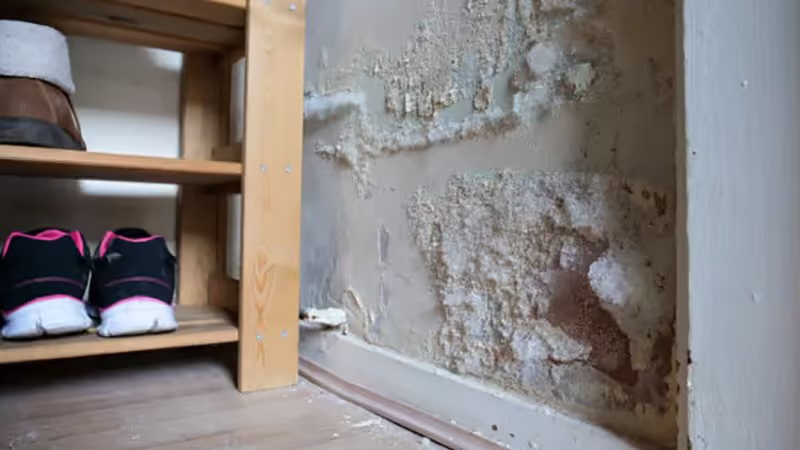
Awaab’s Law, born from the tragic death of two-year-old Awaab Ishak in social housing, is now being extended into the private sector. It represents a major shift in how you handle damp and mould.
The days of simply telling a tenant to "open a window" or "wipe it down with bleach" are over. The onus is now on you. The new regulations will impose strict, legally binding timelines for investigations and repairs. While the exact window is being finalised, the sector expects a requirement to investigate reports of damp within 14 days and begin emergency repairs within 24 hours.
For small landlords, that’s a challenge but documentation is now your best friend. Every report of moisture must be logged, and every inspection and investigation must be evidenced. It is no longer enough to be a "good landlord" who eventually gets things fixed; you must be a landlord who can prove you acted with speed and professionalism.
Perhaps the most significant change will be the introduction of the Decent Homes Standard (DHS) to the private rented sector (PRS). Previously the preserve of social housing, this is now the new baseline for every rental property in the country.
The DHS is more than just a cleanliness check; it’s a four-point criterion test:
Many well-meaning landlords with older Victorian or Edwardian properties may find themselves falling foul of Criterion C or D and this is linked to the EPC rating.
Now is the time to complete an audit of all your properties to assess their condition anticipating when they will need to meet the DHS. Is that kitchen functional but technically "too old" under the new guidelines? Is your insulation up to scratch?
If you fail the DHS, you risk not only fines but also Rent Repayment Orders (RROs) and being barred from using the new Section 8 eviction grounds.
Closely linked to the Decent Homes Standard is the Government’s renewed focus on energy efficiency. With a target for all rental properties to reach EPC Grade C by 2030, the "thermal comfort" requirement of the DHS is already narrowing the window for improvement.
Landlords should be looking for the "easy fixes" in the short-term: LED lighting throughout, new loft insulation or top-ups, and smart thermostats for the radiators. However, the bigger challenge lies in the 2030 deadline. If your property is currently a 'D' or 'E', you need a five-year investment plan. Relying on "exemptions" will become increasingly difficult as the Digital Property Portal goes live.
Every landlord will soon be required to register themselves and their properties on a new Digital Property Portal. This isn't just a database; it’s a compliance gatekeeper.
In the post-May world, if your property isn't on the portal, you cannot legally market it or serve a notice to quit. The portal will likely require you to upload your Gas Safety certificate (Landlord Gas Safety Record/CP12), Electrical Installation Condition Reports (EICR), and the Energy Performance Certificate (EPC). This transparency means local authorities won't need to knock on your door to find a compliance breach—they can find it with a few clicks from their office.
Furthermore, the new Private Rented Sector Ombudsman will provide tenants with a free route to challenge landlords who fail to meet safety standards. For the professional landlord, this is an opportunity to stand out; for the rogue, it should be the beginning of the end.
Local authorities in England are gaining significant new powers to inspect private rental properties and enforce housing regulations, with the primary changes taking effect on 27 December 2025. These powers, introduced under the Renters’ Rights Act 2025, are designed to proactively target "rogue" landlords and ensure compliance with safety and licensing standards. Local authorities have been given significant extra powers to enforce the law.
Council officers now have the legal authority to inspect rental properties without prior notice: they can enter your rented properties to investigate suspected breaches. These can be various, including such breaches of the law as illegal evictions, poor conditions and or failure to register on the new national landlord database. They will give 24 hours' notice to the tenant/s, but there is no requirement to notify the landlord.
If denied entry, councils will apply for a magistrate's warrant to force access to a property if they suspect there are breaches.
Councils in future will be looking for evidence from landlords; they can demand documents from landlords and agents relating to the past 12 months. These include tenancy agreements, right to rent documentation (and the checks you carried out) deposit protection certificates, gas safety records, the EICR, and your EPCs. Officers can also enter letting agents' offices or business premises with or without a warrant—to inspect records and seize devices.
Penalties for non-compliance with all the new regulations are increasing, with fines of up to £7,000 for initial breaches, rising to £40,000 for serious, persistent, or repeat offences.
The extra powers for council officers form part of a wider technical shift in emphasis for enforcement of the regulations where local councils have moved from having the power to investigate to having a legal duty to enforce the landlord legislation.
While many major rental reforms, such as the abolition of Section 21, are due in May 2026, and the DHS is due to come in much later, the enforcement powers given to councils are operative right now (from the 7th of December 2025) introduced earlier to ensure compliance with the existing rules.
Landlords and agents are advised to ensure that all compliance documentation is accurate, up-to-date, and readily available in case it’s asked for, as the focus will then shift to proactive investigations rather than relying solely on tenant complaints.
While landlords and letting agents are rightly focused on 1 May 2026, investigations under the Renters Rights Act 2025 are ongoing, and landlords are warned that local councils will crack down on their compliance enforcement.
To stay ahead of the May deadline, every landlord should adopt a plan to prepare:
First off, conduct a "Decent Homes" assessment of your portfolio. Inspect and identify any Category 1 hazards or aging facilities. Then, carry out any necessary repairs with a priority on ventilation, insulation, and any signs of dampness or condensation to stay ahead of Awaab’s Law.
Finally, gather all the documentation connected with each property you own. Keep this together in a file and digitise it. Ensure that everything is digitised, ready for the launch of the Property Portal.
A major theme behind The Renters’ Rights Act is "professionalisation" of the PRS. While the administrative burden is increasing, this is not the end of the world, it’s not beyond the abilities of the average small-scale landlord to manage.
The changes provide an opportunity to get yourself organised and it could reset the reputation of the private rented sector. By tackling damp and condensation, improving energy efficiency, and meeting the Decent Homes Standard now, well ahead of time, you won’t be just complying with the law, you will protect your investment for the decade ahead.
Tags:











.avif)
%20(800%20x%20450%20px).avif)







Comments