.avif)
-
27/8/26 2:49 pm


Council tax hikes, business rates traps and the real cost of owning a second home or furnish holiday let
Second homes in tourist areas undoubtedly create problems for locals. They drive up prices and rents and create long-term rental scarcity for residents and seasonal workers. They lead to young locals moving away, worker shortages in local services and turn communities into "ghost towns" off-season.
With increasing tourism these issues, which hollow out communities, came to a head. They prompted calls for the Government to intervene. And so, it has, with taxation & regulation. The Government has introduced measures like higher Stamp Duty Land Tax (SDLT) for additional properties and council tax premiums, (often double council tax), while some argue this still isn’t enough.
Some owners feel discriminated against, while many locals demand more action, including planning restrictions and new taxes to control second home numbers and ensure fairness.
There is a fundamental difference between a second home (which is only occupied for a few weeks of the year by their owners) and a furnished holiday let (FHL) business (which is a genuine lettings business for paying guests).
In tourist areas the local economies and other businesses benefit enormously from the revenue injected by holiday let guests. They spend money eating out, on groceries, shopping, booking activities, entertainment etc.
For many years, holiday lets sat in a comfortable “grey” area of the UK tax system. Many were treated as small businesses rather than homes, even where actual letting activity was modest. The distinction meant Business Rates were payable instead of Council Tax, and in many cases full Small Business Rate Relief was claimed.
With the introduction of the regulatory changes in recent budgets, that era has ended.
A series of policy changes introduced through successive budgets has tightened the rules around holiday lets and second homes. The combined effect is higher upfront costs, higher ongoing taxation, and significantly greater risk for landlords whose properties sit close to the FHL qualifying thresholds.
This is no longer a lightly taxed lifestyle investment. For many second homeowners and holiday let owners, it has become a numbers-driven game involving either a profitable operation or an unpredictable ongoing liability.
The government’s decision was simple: there were too many second homes being labelled as holiday lets in name only, benefiting from Business Rates treatment while creating the above issues and contributing little to local economies.
Local authorities and residents lobbied governments, arguing that these properties still relied on residential services — roads, waste collection, emergency cover — yet paid far less towards them than ordinary homes. In tourist hotspots, pressure to act became a strong political issue.
The policy response has been fairly consistent: reduce preferential treatment for second homes and force a clear distinction between genuine holiday let businesses and those used only occasionally privately.
The single most important question for holiday let landlords is how their property is classified, bearing in mind councils will usually default to Council Tax.
If it sits on the Council Tax list, it is taxed as a home. In many areas, that now means exposure to second-home premiums that can double the usual Council Tax bill for an equivalent residential owner-occupied property.
If it qualifies for Business Rates, it is treated as commercial accommodation and where the rateable value is low enough, Small Business Rate Relief can reduce the bill to zero. The difference can run into several thousand pounds per year.
This article applies primarily to England and is not a full interpretation of the rules. Always seek professional advice before making or not making decisions. Use this guide as the starting point for your research, not an endpoint.
Regulatory changes have resulted in the abolition of the previous furnished holiday let regime.
In England, holiday lets must now meet three mandatory tests to qualify for Business Rates:
If a holiday let business, already qualifying for Business Rates, fails any one of these tests, the property will automatically revert Council Tax.
The main shift here is from intention, to providing evidence. The Valuation Office Agency (VOA) now routinely asks for booking records, online letting platform statements, invoices and evidence of marketing activity. Token lettings discounted for “friends and family” stays, or any other artificially low pricing methods, are likely to be caught by the new scrutiny.
Here’s the sort of example that worries genuine landlords. A two-bedroom cottage in a South West coastal town has been run as a holiday let for many years. It does very well in the summer season but struggles to get guests after the peak season.
Over the last 12 months it was available to let for around 160 nights but only achieved lettings for 58 nights. It would then usually be used privately or left empty for the rest of the year.
Under the old regime, this would not have raised any red flags. The property was on the Business Rates list and qualified for 100% Small Business Rate Relief.
But unfortunately for the landlord owner, under the new rules this letting fails the 70-night letting test. When the VOA requests evidence, the shortfall is very clear. The property is reclassified back to Council Tax.
Because this South West council applies a 100% second-home premium, the Council Tax bill effectively doubles. In addition, the charge is backdated to the start of the financial year, creating an unexpected extra tax demand. Although the Business Rates account may eventually be corrected, the cashflow impact is harsh.
From the landlord’s point of view there is a stark choice: swallow the extra cost and continue with the letting business, with the benefit of occasional family use, or sell it as an uneconomic proposition.
Any new holiday let business or property will default to Council Tax initially. A holiday let property cannot move onto the Business Rates list until it has completed a qualifying 12-month period and met the lettings tests. It means new holiday let landlords must budget for Council Tax in year one, even if they expect Business Rates relief to be achieved later.
In Wales, the bar is set higher. Properties must be available for 252 nights and actually let for 182 nights. Many marginal holiday lets - as might be expected - simply cannot achieve this level of occupancy. The result has been a steady drift back into Council Tax in Wales, often with enhanced premiums layered on top.
Consequently, all holiday let businesses in Wales face significant survival challenges due to strict new Welsh Government rules (the 182-night letting rule and council tax hikes).
Intended to increase local housing availability, the measure is leading many holiday let landlords to sell up or face huge tax bills. The Welsh Government is now facing a significant backlash over the measures it has introduced; they have had a substantial impact on tourism jobs and other tourist related businesses in Wales.
The Government in Wales is now consulting on minor flexibility changes (average letting, charity days etc) amidst industry warnings of large job losses and economic harm to rural communities.
To get a clearer understanding of what FHL landlords are up against, here’s an example of a holiday let business in England today:
Property profile
The additional dwelling surcharge is now 5%, on top of standard SDLT rates. That puts the total SDLT on purchase at £22,500, nearly a full year’s gross rent paid before the property earns a penny.
From April 2025, furnished holiday lets lose their special tax regime and are treated like standard residential rentals. So, with a gross income of £24,000 and allowable operating expenses (excluding mortgage) at £6,000, the taxable profit is £18,000. In this landlord’s case, a high-rate taxpayer, income tax at 40% leaving £7,200, less the mortgage interest credit (20%) of £2,200. The landlord’s income tax bill is therefore £5,000.
If the property were to meet the letting tests and qualify for Small Business Rate Relief the rates bill would be zero. But if occupancy slips below 70 nights and the property reverts to Council Tax the bill would be £2,150 and with the second-home premium of £2,150 it would be £4,300 per year.
With Business Rates the net cashflow of the business is around £2,000 profit but with Council Tax the net cashflow is around negative £2,300 – a loss. The new FHL business is on a knife edge - one poor season would be enough to flip the single holiday let property from being marginally profitable to loss-making.
Double taxation may not be quite as harsh as it seems. We see headlines about double Council Tax but this can sometimes reflect timing issues rather than permanent high charging.
When a property is reclassified half-way through the year, for example, landlords may temporarily face backdated Council Tax demands. The Business Rates bill may not yet have been closed off and there can be long delays before refunds are processed. It can result in cash-flow issues for these businesses.
Small Business Rate relief is by no means automatic. It is a valuable concession for the holiday let business but it’s conditional. Running multiple FHL properties, changes in rateable values, or failure to meet the letting tests can all remove entitlement to this relief. Prudent landlords should not rely on this concession but budget on the assumption that Council Tax applies, unless they are sure of watertight evidence.
These rule changes came as a shock to seasoned FHL holiday let landlords and some second home owners.
Holiday lets and second homes are no longer lightly taxed or loosely regulated. Preferential treatment has been taken away and the thresholds tightened. Local councils have had their tax powers strengthened.
For professional operators in locations with strong demand, holiday lets can still work, but for marginal properties, the margin for error is extremely tight. The new reality is quite simple: run a genuine business that stands up even if Council Tax applies, or rethink your strategy entirely.
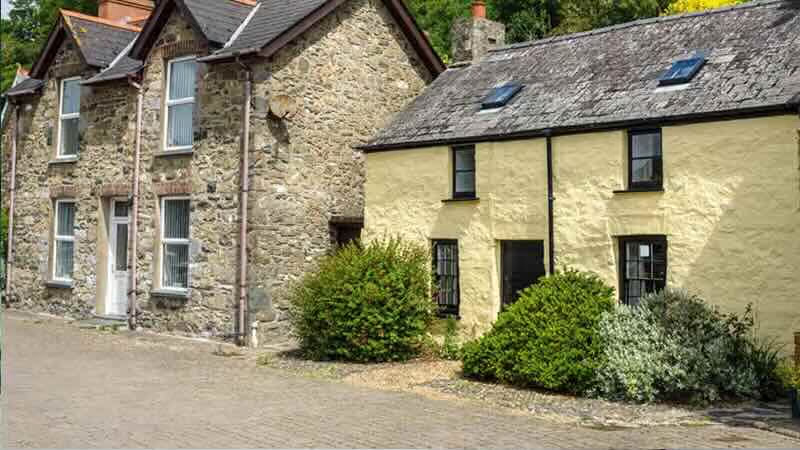
[Main image credit: Andrew Reed]
Tags:












%20(800%20x%20450%20px).avif)
.avif)







Comments