.avif)
-
27/8/26 2:49 pm


It is possible to turn a cost headache into a smoothly managed system
For landlords owning HMOs, blocks of self-contained flats or a mixed-use property, with usually one utility supply, ever-increasing utility bills need to be divided out fairly and quickly between tenants to make life a lot easier.
Utilities charges have quietly become one of the most problematic costs in multi-occupancy rental property. For those landlords operating HMOs, blocks of self-contained flats, or mixed-use buildings with shared supplies, energy and water costs can erode your profit margins, trigger disputes, and create persistent operational headaches.
Unlike mortgage costs or insurance premiums, utilities are volatile, difficult to forecast, and often only partially recoverable. The problem is compounded where multiple tenants share a single incoming supply, making it hard to divide costs fairly, transparently, and efficiently.
This is an underserved area of the private rented sector. Many landlords still rely on blunt, outdated approaches. For example, they bundle bills into the rent, charge flat rates, or manually split invoices. This, despite the availability of more precise, data-driven solutions.
As utility costs rise and tenant expectations and scrutiny increase, utility management is shifting from a minor admin task to a critical load on profitability.
Often the core issue is structural: Many multi-let properties were never designed for modern, tenant-level billing. Converting them to separate metering for all the utilities supplies usually would be technically difficult and financially unviable.
HMOs often have a single gas, electricity, and water supply with blocks of flats converted from former single dwellings. Mixed-use buildings will often have shared plant and communal services, coupled with the fact that these properties have high tenant turnover and short tenancies.
Hence, utilities have become a pain for multi-occupancy landlords. Firstly, electricity costs have been rising far faster than rents. Since 2020, rents have increased by around 25 per cent, while electricity prices have jumped by roughly 55 per cent in the same period. (ONS Index of Private Housing Rental Prices (Dec YoY change, 2020–2024); ONS RPI Electricity Inflation).
For landlords operating on a model where utility bills are included in the rent, it means margins have been steadily eroded and probably suggests that this approach is unlikely to be financially sustainable going forward.
Secondly, much of the UK’s rental stock is old, and many large properties that have been converted to multi-occupancy set ups were never designed to give each unit its own connection to the main electricity, gas and water suppliers in the UK.
Retrofitting a property so that each unit has its own direct connection to the grid, the gas network or the water board is often prohibitively expensive and has long lead times (2 plus years) or is physically impossible because of the building’s layout.
Thirdly, regulation is evolving. Ofgem is becoming the heat network regulator for Great Britain, with the first authorisation conditions taking effect from today, 27 January. These changes are pushing landlords towards fairer, more transparent billing for tenants, something that is only achievable with accurate, unit-level consumption data, which many landlords currently lack.
When combined with late supplier billing, a lack of smart meters from the suppliers and tenant turnover, it becomes extremely difficult for landlords who run independent utility networks to manage utilities fairly while also recovering their true costs.
Fortunately, with modern technology, there are solutions out there.
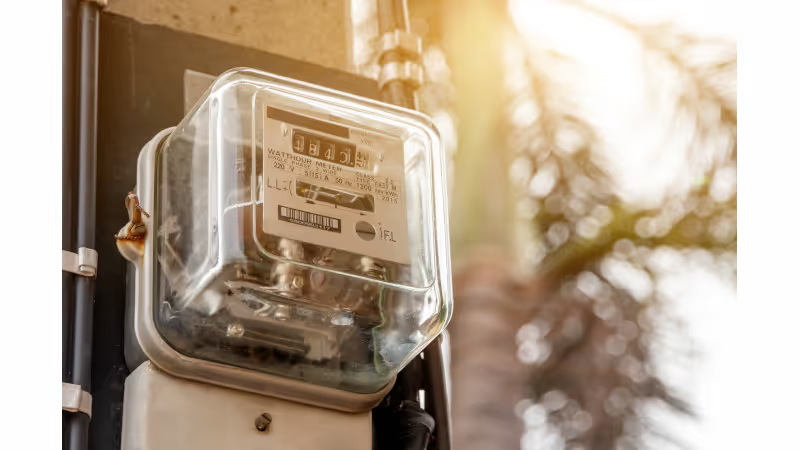
You can introduce sub-metering where it makes sense. For many landlords, sub-metering is the practical middle ground between doing nothing and attempting direct connections to the grid, water or gas networks.
Sub-meters alongside utility management services can enable landlords to recover their utility costs through unit-level consumption data, fair charging and tenant support, all without the need for major infrastructure work.
You could separate communal consumption from tenant consumption. If you have a building with a communal area you can choose to separate this and either cover the costs directly or split this between the tenants using the space.
Alternatively, you could choose an all-inclusive utilities management service. Choosing a service like this offers tenants the ability to interact with exactly what they've used over a given period, they can also see a live account balance and make payments online. This will significantly reduce the administrative burden on landlords and improve transparency for everyone.
One such solution is the “MyUnit” (https://www.myunit.co.uk/), which offers sub-metering and tenant billing solutions aimed at HMOs and multi-unit landlords. MyUnit manages electricity, gas, heat and water networks on behalf of landlords. It enables landlords to deliver utility management that’s efficient and compliant for landlords, and always fair and transparent for tenants.
Similar services are emerging across the PropTech and utilities management sector, reflecting growing demand for smarter cost recovery systems.
The commercial logic is simple: If landlords can measure usage accurately, they can recover costs fairly and predictably — without absorbing unnecessary losses.
Experienced landlords Chris Scorer of Slasco Properties explains:
“We run a large portfolio covering both social housing and privately rented stock, and recovering the costs for our utilities was really hurting our bottom line. We decided to roll out a utilities management and sub-metering service.
“In some properties we only needed this for electricity, while in others it made sense to cover all utilities. This has enabled us to regain control of our costs and ensure tenants are charged fairly for the utilities they use.”
When landlords pay the utility bill upfront and attempt to recover costs later, under-recovery is common. Standing charges, seasonal spikes, vacant rooms, and unpaid balances can leave landlords subsidising tenant consumption, leaking costs and eroding their profit margin.
Tenants often question how shared bills are calculated. Flat-rate charges or rough splits can feel arbitrary, fuelling complaints and disputes, especially in cost-of-living pressure environments. Perceived unfairness results in strained landlord-tenant relations and disputes.
Manually dividing bills across multiple tenants, recalculating charges as occupants move in and out, and chasing payments creates a relentless ongoing admin workload, particularly burdensome for HMO portfolio landlords.
Landlords typically pay suppliers first, then attempt to recover tenant contributions later which leads to cash flow issues, and it exposes them to late payments, arrears, and bad debts.
Some landlords include utilities in the rent to simplify billing which may be simple to administer and avoids billing disputes, but it encourages overconsumption, exposes landlords to price volatility and makes margins unpredictable.
Charging a fixed amount per room or per unit is another common charging regime in HMOs. It gives predictability for tenants and is easy to administer, but it rarely reflects real usage, risks under-recovery or overcharging and can raise fairness and regulatory concerns.
In theory, each tenant or flat has their own meter and utility account which may be ideal but in practice it’s often impractical to achieve in shared-supply buildings, it is administratively time consuming, suppliers may resist multi-account setups and retrofitting individual supplies can be costly or technically unviable. For many landlords, none of the above provide a clean, scalable solution.
Utility costs are no longer a background expense; they are now a recoverable operational cost centre. Professional landlords increasingly recognise that transparency reduces disputes, accurate measurement improves fairness, data-driven billing improves recoverability, usage visibility encourages conservation and smarter billing improves tenant trust and retention.
As we all know, energy costs remain structurally higher than historic norms, landlords who fail to modernise their utility systems risk cutting their profit margins by subsidising utilities costs.
One increasingly adopted solution is sub-metering, that is installing secondary meters that measure usage per room, flat, or unit without requiring full separation of the main incoming supply. This sits between two extremes of using the old methods or attempting costly infrastructure upgrades or direct grid separation.
Sub-metering enables the tracking of actual consumption at unit or room level, fairer allocation of energy and water costs, transparent, auditable billing, better tenant accountability and reduced landlord exposure to excessive consumption. Sub-meters provide accurate usage data without requiring a complete rewiring or replumbing of the building, making them commercially viable in many retrofit scenarios.
Hardware alone does not solve the whole problem. The administrative and billing layer is just as difficult but still important. Some specialist firms now combine a sub-meter installation with automated billing platforms, incorporating tenant dashboards and portals, with payment processing, reporting and audit trails
This reduces landlord involvement in day-to-day management of billing while improving transparency for tenants.
This is where companies like MyUnit and ProTech, offering sub-metering and tenant billing solutions aimed at HMOs and multi-unit landlords, come in. These services are emerging across the utilities management sector, reflecting growing demand for smarter cost recovery systems.
For portfolio landlords, these solutions drastically cut down management time and can compound into material annual savings, particularly where energy and water costs exceed several thousand pounds per property per year.
When tenants can see their own consumption, behaviour changes as studies and industry experience suggest that tenants moderate their heating usage when billed directly and transparent billing also reduces the perception that landlords are profiteering from utility charges.
Under consumer protection rules, landlords who recharge utilities must ensure tenants are not unfairly overcharged relative to actual costs. Metered usage, supported by documented billing, strengthens a landlord’s position if charges are challenged.
[Main image credit: SevenStorm JUHASZIMRUS]
Tags:











%20(800%20x%20450%20px).avif)
.avif)





Comments