.jpg)
-
22/10/26 11:05 am


The gap between house and flat prices has reached its widest level in three decades, with the average UK house now worth 1.7 times as much as a flat, according to new Zoopla research.
The average price of a house has gone up 43% since 2016 across the UK, but flats have increased by just 10% during the same period, meaning that a flat now costs £193,000, compared with £327,000 for a house. Outside London, a house costs 2.3 times the price of a flat, up from 1.8 times in 2016, while in London the ratio is 1.9 times meaning that seven in ten London first-time buyers are actively looking for a flat, which keeps the house-flat ratio more in check.
In Scotland, where the long leasehold system doesn’t apply and flat owners hold the freehold of their property, the same house to flat price ratio stands at 1.9 times - almost identical to its level in 2016 (1.8x) and barely changed in 30 years.
Zoopla analysis of leasehold listings shows the typical leaseholder pays £200 a year in ground rent and £1,900 a year in service charges - a combined £2,100 a year.
However, the growing gap between the price of a house and flat goes beyond running costs, Zoopla explains, as affordability also plays a role. The flat-house price gap is widest in the Midlands and Northern regions, where houses are affordable enough that many first-time buyers skip flats entirely.
Richard Donnell, executive director at Zoopla, believes buyers who invest time to research and understand the system and get support can take advantage of the gap between flat and house prices. “A well-managed building with a long lease and stable service charges is a very different proposition from a property with less clarity on service charges and a short lease,” adds Donnell.
The government has vowed to abolish the leasehold system but recently admitted that legislation including changes to enfranchisement and Right to Manage may not be brought in until after this Parliament.

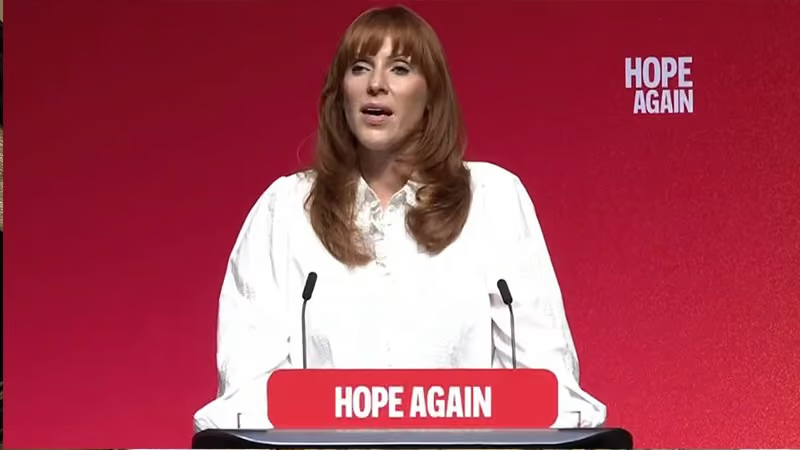
Purchasers are increasingly factoring in leasehold arrangements, service charges, building safety considerations and other ongoing costs when making decisions, says Propertymark CEO Nathan Emerson (pictured).
“The contrast between Scotland and England is particularly noteworthy,” he adds. “The relative stability in Scotland suggests that simpler ownership structures can help support buyer confidence and maintain demand for flats over the longer term.”
Property expert Kate Faulkner says flats could be a good choice for landlord investors, as long as they look at yield not capital growth.
“Typically, rents vary less than house prices, so the yield should be higher on flats but you have to take into account the higher cost of a flat due to service charges, and check if there is a sinking fund, building safety issues etc,” she tells LandlordZONE.

“Also with the new decent homes standard and Awaab’s Law, you need to make sure you can let legally and safely as some condition issues are outside of a landlord’s control.”
Faulkner says that the issue with flat values is more about affordability. “Back in 2014, first time buyers essentially had the price they could pay 'capped' due to mortgage restrictions. House purchases are less affected as more are owned outright and more buyers are likely to have cash, and lower LTVs."
She adds: “It may be that as commonhold comes in and leasehold rules are more in favour of owners, there may be some reduction in the current variance, but I think that will be tough to measure.”
Tags:











.avif)
%20(800%20x%20450%20px).avif)




Comments