.avif)
-
27/8/26 2:49 pm


A major HHSRS overhaul, the road to Awaab's Law and £7,000 instant fines
Two significant changes to housing safety law come into force within 24 hours of each other this week.
On Monday 22 June, councils across England gain the power to issue civil penalties of up to £7,000 where private landlords have serious hazards in their properties. Secondly, the primary tool councils use to assess hazards in rentals has been revised and updated, introduced on 23 June 2026.
The reformed Housing Health and Safety Rating System (HHSRS) used to assess danger in rental homes is the first fundamental overhaul of the statutory hazard assessment framework in 20 years.
And, looking further ahead, most likely towards the end of this year or next, these changes set the scene for the introduction of Awaab's Law to the PRS, the regime of legally binding deadlines for repairs, and a system that is already operating in social housing.
This article refers to English law. It is not a definitive interpretation of the law. Every case is different; rules change over time and only a court can decide. Always seek expert advice before acting or not.
The HHSRS is the (statutory) risk-assessment system (tool) that assists councils enforcing housing safety law in England. It was originally used in 2006 as Part I of the Housing Act 2004 and it applies to all residential property, whether privately rented, social or owner-occupied.
It is a risk assessment framework councils use when inspecting homes, assessing homes for hazards and deciding whether to take enforcement action against a landlord.
Under the old system, a council officer would assess a property against 29 separate hazard categories. They would then allocate a numerical score to each hazard found, using a ten-point rating from A (posing an imminent threat to life) to J (minimal risk).
The system was cumbersome, not easily replicated or interpreted by landlords. Calculating a reliable hazard score required the assessor to estimate the probability of harm across a range and severity of the possible outcomes. They compounded this by applying a weighting factor for each age group most vulnerable to a particular hazard.
In practice, the complexity of the system led to inconsistent results with different assessors and different local authorities arriving at different conclusions. It brought into doubt the reliability and validity of the scores produced and it was difficult for landlords and tenants to understand and reproduce.
After an extensive review the revised system, commissioned by the government and led by RH Environmental (now RHE Global), has considerably simplified the old procedure. The aim was to update the HHSRS process, to simplify its application and bring it into alignment with the Building Safety Act 2022.
The government has stated that the intention was to improve the assessment system, not to change the safety standards for landlords. The amended regulations come in through The Housing Health and Safety Rating System (England) (Amendment) Regulations 2026 (SI 2026/571 on 23 June 2026.
The 29 hazards of the old system have been reduced and consolidated into 21 hazard categories. Eight of the old hazards have been merged into related categories and grouped under four headings:
Protection against accidents – falls on the level. Falling on stairs, etc.; Falling between levels; Fire and explosions; Flames, hot surfaces, etc.; Collisions, entrapment and ergonomics; Structural collapse and falling elements; Electrical hazards
Physiological requirements – Excess cold, radiation, damp and mould growth, lead, indoor air pollutants, excess heat, asbestos and manufactured mineral fibres.
Psychological requirements – Entry by intruders; lighting; noise.
Protection against infection – domestic hygiene, pests and refuse; Food safety: Personal hygiene, sanitation and drainage
In practice, the hazards landlords should focus on are basically the same as the old ones: damp and mould, excess cold, fire risks and electrical safety. In that respect, the changes don’t create anything new; they just simplify and streamline the assessment process.
There’s also a change to the old ten-point scoring system (A-J), replaced by just three categories of High, Medium and Low.
Any category rated as “High” will automatically trigger a council's duty to take enforcement action immediately.
The definition of a fire hazard has been extended under the new system to align it more closely with the Building Safety Act 2022, particularly relevant to landlords with flats and HMOs.
Baseline indicators will be produced and are meant to be objective, measurable thresholds for each hazard that help a council assessor and landlords to determine whether a hazard is present and, if so, how severely to score it. They aim to bring consistency and transparency to the assessment process, something that was previously thought to be lacking.
Baseline indicators give landlords a reference point for self-assessment. It should be possible to tell if your property meets the baseline for the 21 categories without outside help. If it does not, it is likely to be marked down on assessment as a Category 1 or Category 2 hazard. This is likely to be a useful pre-inspection tool for landlords.
The new civil penalty was introduced by the Renters’ Rights Act (RRA) and now operates by reference to the HHSRS system. From 22 June 2026, a council can issue a financial penalty of up to £7,000 to a landlord where a Category 1 (High) hazard is identified in a private rented property.
The government has estimated that around 10% of all private rented homes have at least one Category 1 hazard, so the risk of a fine is considerable in the PRS as a whole. The penalty applies across all 21 hazard categories, but in practice the most dangerous hazards encountered, the Category 1 hazard, in residential lettings are damp and mould, excess cold, fire risks and electrical defects.
This £7,000 penalty is in addition to existing council enforcement powers. Improvement notices, prohibition orders, hazard awareness notices, emergency remedial action and cost recovery are all still available to the council. They have a wide menu of options.
To impose a penalty on a landlord, the council must be satisfied “on the balance of probabilities” (the civil standard of proof) that both the hazard exists and that the landlord should have removed it. Mostly, a landlord who can demonstrate prompt action following a tenant report will be in a strong position.
Landlords have a right of appeal against a penalty.
The council can impose a penalty for each separate Category 1 hazard, so more than one penalty can be imposed.
The government wants to see councils using their powers across England. It is urging councils to use “every available power to tackle unsafe housing”.
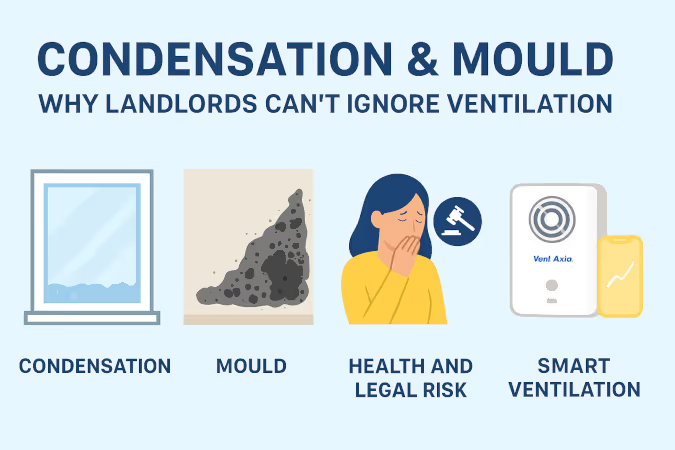
Awaab's Law is a new law for the PRS chiefly concerning damp and mould hazards.
The law is named after the case of Awaab Ishak, a two-year-old boy who died in a Rochdale social housing flat in December 2020. The coroner's report, published in November 2022, found that Awaab's death was directly caused by prolonged exposure to mould in the housing association flat where he lived with his parents.
The case was a watershed moment in rental property law in England. It focused media attention on the state of much of the rental property stock and to the inadequacy of the housing safety regulations at the time.
The case resulted in amendments to the Social Housing (Regulation) Act 2023 which created a new framework for Awaab's Law. It introduced legally enforceable timeframes within which landlords must investigate and remedy hazards once they have been reported by a tenant.
This significantly changed the existing position under section 11 of the Landlord and Tenant Act 1985, which required landlords to complete repairs within a "reasonable period".
Phase 1 of Awaab's Law came into force for social housing on 27 October 2025. Social landlords are now under a legal obligation to deal quickly with damp and mould hazards. They have 14 days following a tenant report and a fix within a further 7 days to deal adequately with the hazard and with remediation within a further 7 days of investigation. All emergency hazards must be dealt with as quickly as possible and normally within 24 hours.
Awaab's Law is being introduced in stages, with the PRS extension arriving later as part of Phase 3 of the RRA. The current timetable for social housing and the projected position for private landlords are the following:
Phase 1 introduced Awaab's Law for damp and mould plus all emergency hazards in the social housing sector 27 October 2025
Phase 2 introduces further hazards to the brief for the social housing sector: cold/heat/falls, fire, structural collapse and hygiene in October 2026.
A Phase 3 addition introduces all the remaining HHSRS hazards but excludes overcrowding in social housing sometime in 2027.
Phase 3 also introduces an extension of Awaab’s Law to the private rented sector (PRS) sometime in 2027, subject to further consultation but likely to mirror the application in the social housing sector.
See GOV.UK Awaab's Law guidance (October 2025) and the government's Implementation Roadmap for the RRA, published last November.
Awaab’s Law will use the same HHSRS 21 hazard categories now in force under the revised system. Landlords who use the new HHSRS standards will be effectively complying with the future introduction of Awaab's Law.
1- Carry out a risk assessment for each of your properties measured against the new 21 HHSRS hazard categories.
2 – Identify any Category 1 hazards without delay and address the problem by swift remedial action. Don’t wait for a tenant complaint.
3 – Instigate and maintain a repair and maintenance log for each property you own and rent out. You need to produce an audit trail, a log of repair requests, retain all invoices, risk assessments, and all correspondence with tenants.
4 – Have a complaints policy and inform your tenants how they can report requests for repairs. Your tenants need to know how to report concerns and that reports are time-stamped and documented.
The HHSRS reforms, the new civil penalties and the introduction of Awaab's Law are important milestones in the government’s pathway to improving standards in the rented housing sector. The assessment process is being simplified to aide landlords’ understanding, but remediation timescales will be short, and penalties will remain a serious threat for those who fail to comply.
Tags:












%20(800%20x%20450%20px).avif)
.avif)






Comments