.avif)
-
27/8/26 2:49 pm


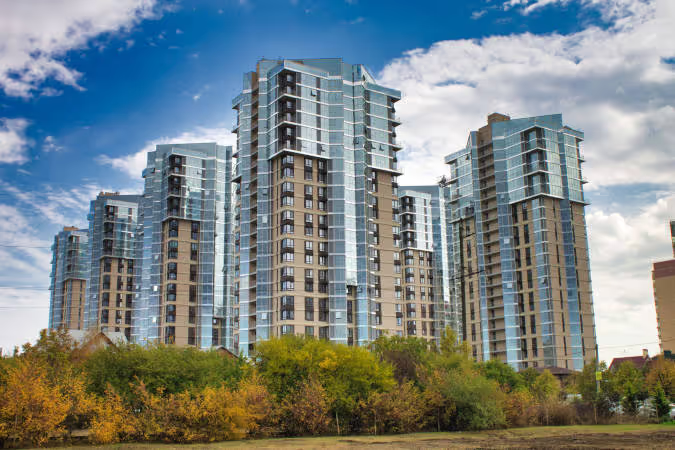
Many landlords and leaseholders remain unable to buy, sell or remortgage flats affected by cladding or external wall fire safety concerns because mortgage lenders remain cautious about lending against these properties. Despite official guidance and government remediation schemes, documentation requirements and lender risk appetite continue to affect transactions across the UK housing market.
This article explains why mortgage problems persist on cladding-affected homes, how industry practice has evolved, and what landlords and leaseholders can do to navigate these challenges.
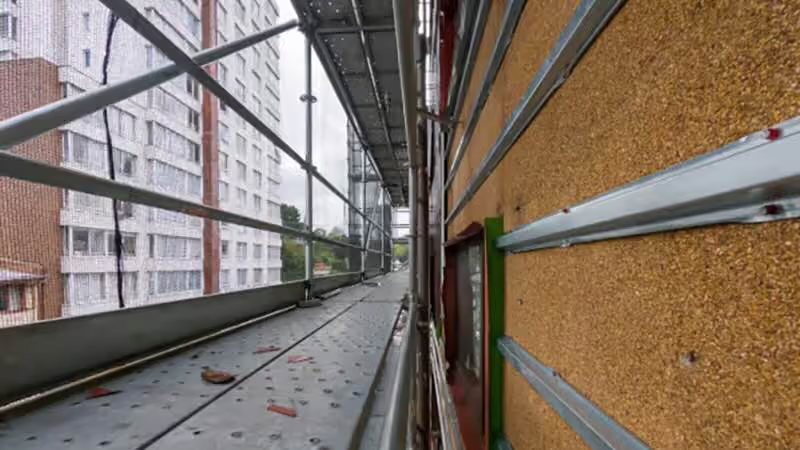
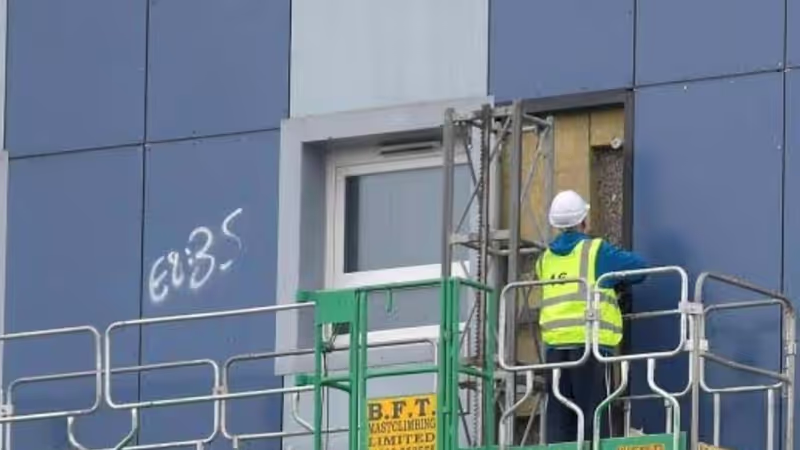
Cladding refers to the external materials fixed to a building’s façade. It became a major mortgage issue following the Grenfell Tower fire in 2017, which exposed the fire risk posed by some combustible cladding systems. As a result, lenders and surveyors now assess external wall safety far more closely before approving mortgage offers on flats in affected buildings, particularly in medium and high-rise blocks.
One of the most widely recognised forms of evidence has been the External Wall System (EWS1) form, introduced by RICS and the mortgage industry to help lenders assess fire risk. However, government guidance has since made clear that an EWS1 form is not a legal requirement for every building, and should only be requested where there is a clear fire safety concern.
To address widespread concerns that mortgage lending was being unnecessarily restricted, lenders and industry bodies have updated their approach to cladding-related risk.
A revised industry statement on cladding, backed by UK Finance and the Building Societies Association, clarified that lenders should not automatically require new EWS1 forms where existing assessments remain valid, and should consider alternative evidence where appropriate.
This includes the use of:
Legal analysis of the updated guidance confirms that lenders now have more flexibility when assessing fire safety risk, although individual lender policies still vary.
Government data shows that EWS1 or equivalent documentation is now required in a minority of mortgage valuations, and is most common in taller buildings:
This data reflects a shift towards a risk-based approach, rather than blanket requirements.
Despite improvements in guidance, some leaseholders and landlords continue to face difficulties because:
These issues can make properties harder to sell or remortgage, particularly where remediation is ongoing or communication between parties is poor.
The Building Safety Act 2022 introduced significant protections for leaseholders, limiting when they can be charged for cladding remediation and establishing clearer accountability for building owners.
Government funding schemes such as the Building Safety Fund and the Cladding Safety Scheme aim to accelerate remediation and provide reassurance to lenders that unsafe materials will be removed without placing costs on leaseholders.
Where a building is enrolled in one of these schemes, lenders are increasingly willing to consider mortgage applications — even where remediation is not yet complete — provided appropriate evidence is available.
Before selling or remortgaging, leaseholders should obtain all available fire safety documentation from managing agents or freeholders, including any existing EWS1 forms, FRAEW reports or confirmation of remediation programme enrolment.
Clear communication about remediation timelines and funding arrangements can help reassure valuers and lenders and reduce delays.
Mortgage brokers experienced in cladding-affected properties can help identify lenders with more flexible criteria and guide applicants through documentation requirements.
This is particularly important for landlords seeking buy-to-let mortgages on flats with non-standard construction or additional risk factors.
Why does cladding affect mortgage approval?
Lenders need assurance that a building’s external wall system does not pose an unacceptable fire risk. Where this risk cannot be clearly assessed, lenders may restrict or decline mortgage lending.
Is an EWS1 form legally required?
No. Government and industry guidance confirms that EWS1 forms are not mandatory for every building and should only be requested where there is a specific fire safety concern.
Can a flat with cladding still be sold or remortgaged?
Yes. Many lenders will proceed where alternative risk evidence is available or where the building is covered by remediation schemes and statutory protections.
Do all lenders treat cladding risk the same way?
No. Policies vary widely, which is why specialist advice can be important.
Cladding-related mortgage issues are gradually easing as guidance improves and remediation progresses, but they have not disappeared entirely. For landlords and leaseholders, staying informed, gathering documentation early and understanding lender requirements remain essential to avoiding unnecessary delays or failed transactions.
Tags:








%20(800%20x%20450%20px).avif)
.avif)



Comments